The useful starting point
Report an active condo leak promptly to the association or manager and your insurer as appropriate, while arranging safe source control and damage documentation. Determine responsibility from the governing documents, actual findings and policy terms. The location of a stain alone does not decide who must pay.
Deal with the active condition before the cost debate
Notify the building's emergency contact and describe the exact location, whether water is still arriving and any immediate safety concern. Water near electrical fixtures, a bulging ceiling or possible contaminated water needs prompt professional assessment. Keep people away from the affected area. Do not enter another unit, manipulate shared equipment or open walls without the appropriate access and authorization.
Follow the initial call with a short written record. State the time, rooms affected and what you observed, without assigning blame. Attach a few useful photographs. Ask who is arranging source investigation and who needs access to your unit. The association may need to coordinate several households before the cause is clear; a single current contact helps avoid conflicting instructions to contractors.
Read three sets of documents for three different questions
The master deed and related condominium documents describe the ownership arrangement and responsibilities. The association's insurance policy describes its coverage. Your unit-owner policy describes yours. These documents answer related but different questions, so do not substitute one for another. Massachusetts consumer guidance explains that condo owners need coverage for items outside the association's master policy.
Obtain the current governing documents and amendments from the association or manager. Separately, ask each insurer which provisions apply to this event, what deductible may apply and what documentation it needs. Labels such as 'all-in' or 'walls-in' are no substitute for the policy wording. If the parties disagree about interpretation or responsibility, Massachusetts condominium guidance points legal questions to an attorney with relevant experience.
| Question | Starting record | Who can clarify |
|---|---|---|
| Who maintains this component? | Governing documents and amendments | Association and condominium attorney |
| What does a policy cover? | Actual policy and endorsements | Insurer or licensed insurance professional |
| Where did the water originate? | Inspection findings and event record | Appropriate investigating trade |
| What must be repaired? | Material assessment and scope | Restoration and repair professionals |
Document the path across units and common areas
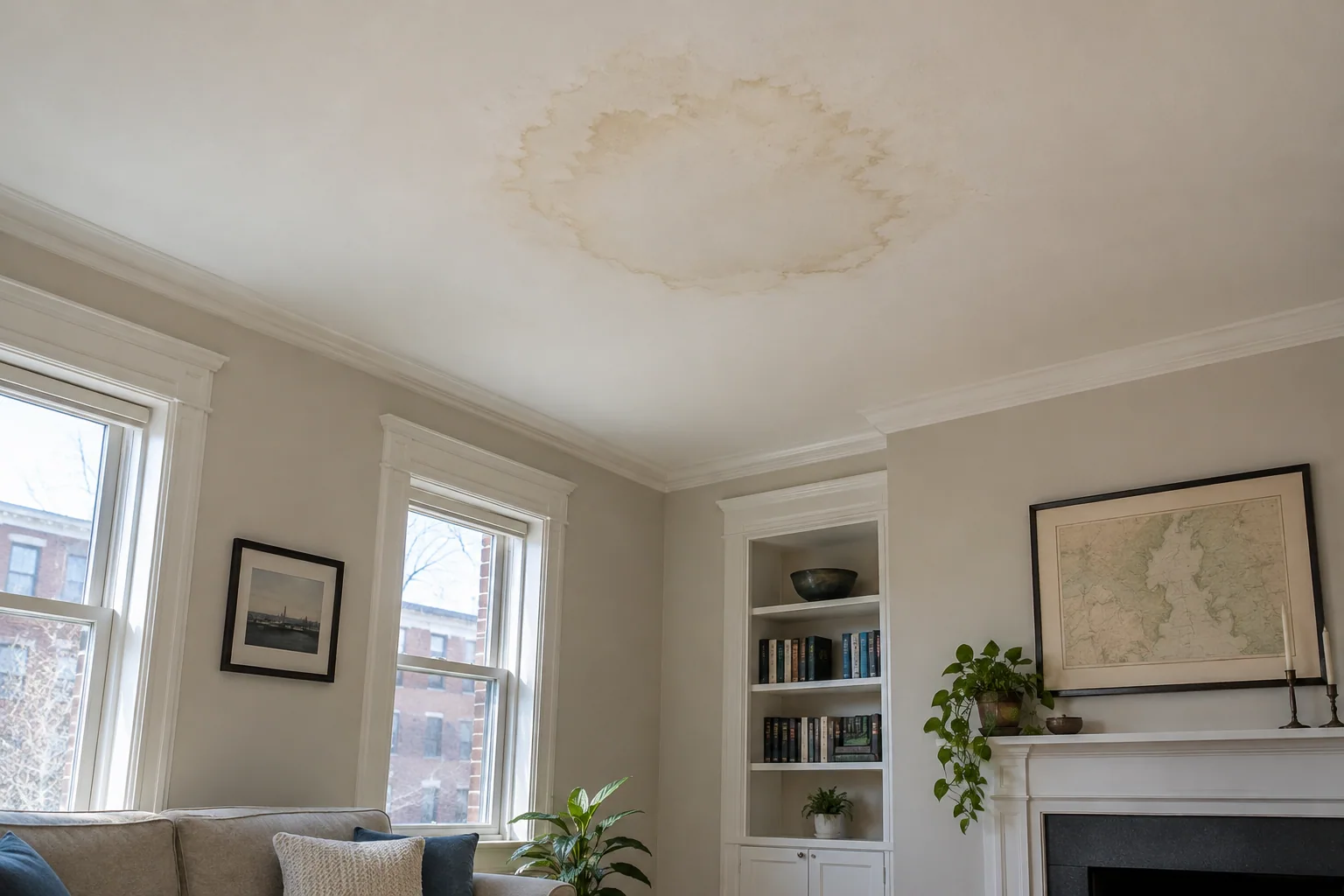
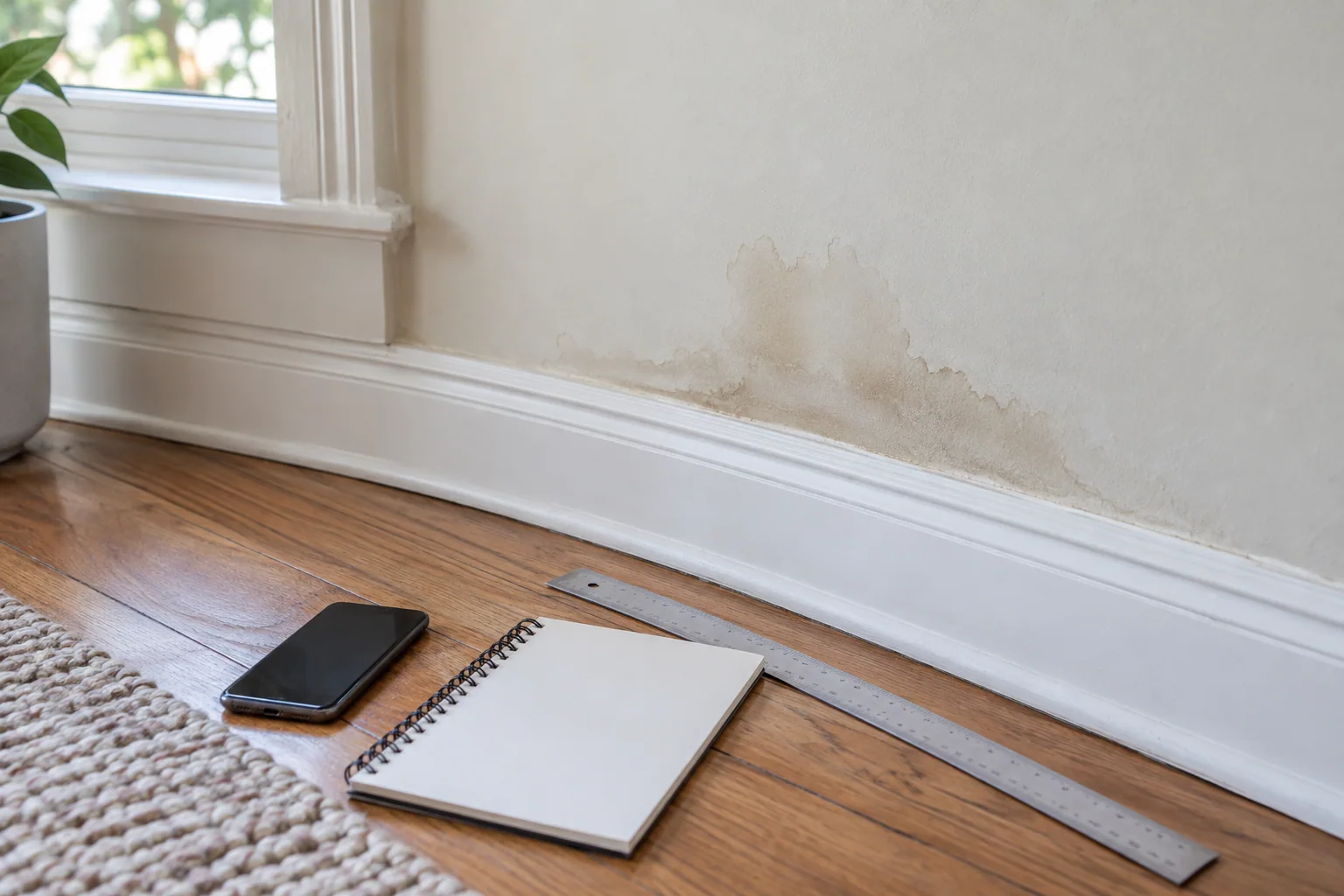
Make a room-by-room record of damage in your own unit. Include an overview, a close-up and a location description for each affected surface. Keep dates, messages, receipts and contractor reports in one folder. Ask the building contact to coordinate a separate record of common areas and other units rather than circulating everyone's private photographs without a reason.
The investigation should identify what is confirmed, what is suspected and which spaces could not be accessed. A pipe above the ceiling may serve one unit or several; its position alone does not answer that question. Where a roof or wall leak is possible, include weather and exterior observations. Ask for a diagram or plain-language description of the route so the repair scope can be checked against the findings.
Clarify authority for emergency and permanent work
An emergency authorization can be narrower than a complete rebuilding agreement. Before signing, understand which work the contractor will perform, who is ordering it and who receives the invoice. Ask whether the scope includes only stopping water, or also extraction, opening assemblies, drying, cleaning and reconstruction. Do not assume a contractor has authority to make coverage promises for an insurer.
The association should identify its decision process for shared components and common-area access. Owners should clarify the process for their own finishes and belongings. Put changes in writing when the investigation reveals additional damage. A good change description identifies the new finding, the work required and who is approving it. This is more useful than a broad permission to do whatever becomes necessary without another conversation.
Coordinate the work around an occupied building
Ask for a plan covering work hours, entry arrangements, equipment, dust control and any interruptions to water or electricity. Shared hallways and stairs need to remain usable as required; temporary storage cannot simply expand into every convenient space. Residents should know whom to contact if a machine stops, a new stain appears or access arrangements change.
Older buildings need special attention before painted surfaces or suspect materials are disturbed. Include the appropriate evaluation and work practices in the scope. If an affected assembly contributes to separation between units, ask the responsible professional how it will be restored, including any applicable inspection requirements. The visible finish is only one part of that assembly. Keep photographs and records of concealed work before the ceiling or wall is closed.
Close the project with a shared factual record
Request separate confirmation of source repair, material assessment and completion of rebuilding. The same company may perform all three, but they remain different tasks. A dry-looking ceiling does not establish that the source was found, and a repaired pipe does not establish that surrounding materials were assessed. Ask what was measured or inspected and what limitations remain.
Keep final invoices, warranties, relevant inspection records and follow-up instructions with the association's building file and your own claim file. For a recurring leak, set a practical observation point after similar rain or system use. If the parties still disagree about payment, preserve the records without rewriting the physical findings to support a preferred outcome. A clear account of what happened is valuable to everyone handling the repair or dispute.
Your field checklist
- Notify the manager or association promptly and follow up in writing.
- Record damage by room without deciding liability from appearance.
- Obtain governing documents, amendments and actual insurance policies.
- Clarify the scope and payer named in each work authorization.
- Coordinate access, utilities and occupied-building precautions.
- Keep source findings and concealed-work records with the final repair file.
A few common questions
Does the upstairs owner automatically pay for a leak?
No automatic rule can be established from the location alone. The source, governing documents, policy terms and other facts may matter. Ask the association and insurers for their positions, and seek condominium legal advice if responsibility is disputed.
Should I contact my insurer if the roof is a common element?
Contact your insurer promptly to ask about notice and claim requirements under your policy. A common source does not by itself tell you which policy addresses interior damage, belongings or other losses.
Can I repaint before the association finishes investigating?
Discuss it with the investigator and insurer first. Painting can hide evidence and may be premature if moisture remains. Keep photographs and agree on the condition that must be met before finish repairs proceed.
Sources & further reading
- CondominiumsCommonwealth of Massachusetts
- Understanding Home InsuranceMassachusetts Division of Insurance
- Renovation, Repair and Painting Program: ConsumersU.S. Environmental Protection Agency
This guide supports informed conversations about your home. Conditions, materials and local requirements vary; an on-site assessment is necessary for decisions about a particular property.