The useful starting point
Report the leak to building management and the affected neighbor promptly, then keep a dated record of visible damage and access requests. Coordinate investigation across units. The water's origin, repair responsibility and insurance coverage are separate questions; governing documents, inspection findings and policy terms determine how they fit together.
Start with the ceiling, not the argument
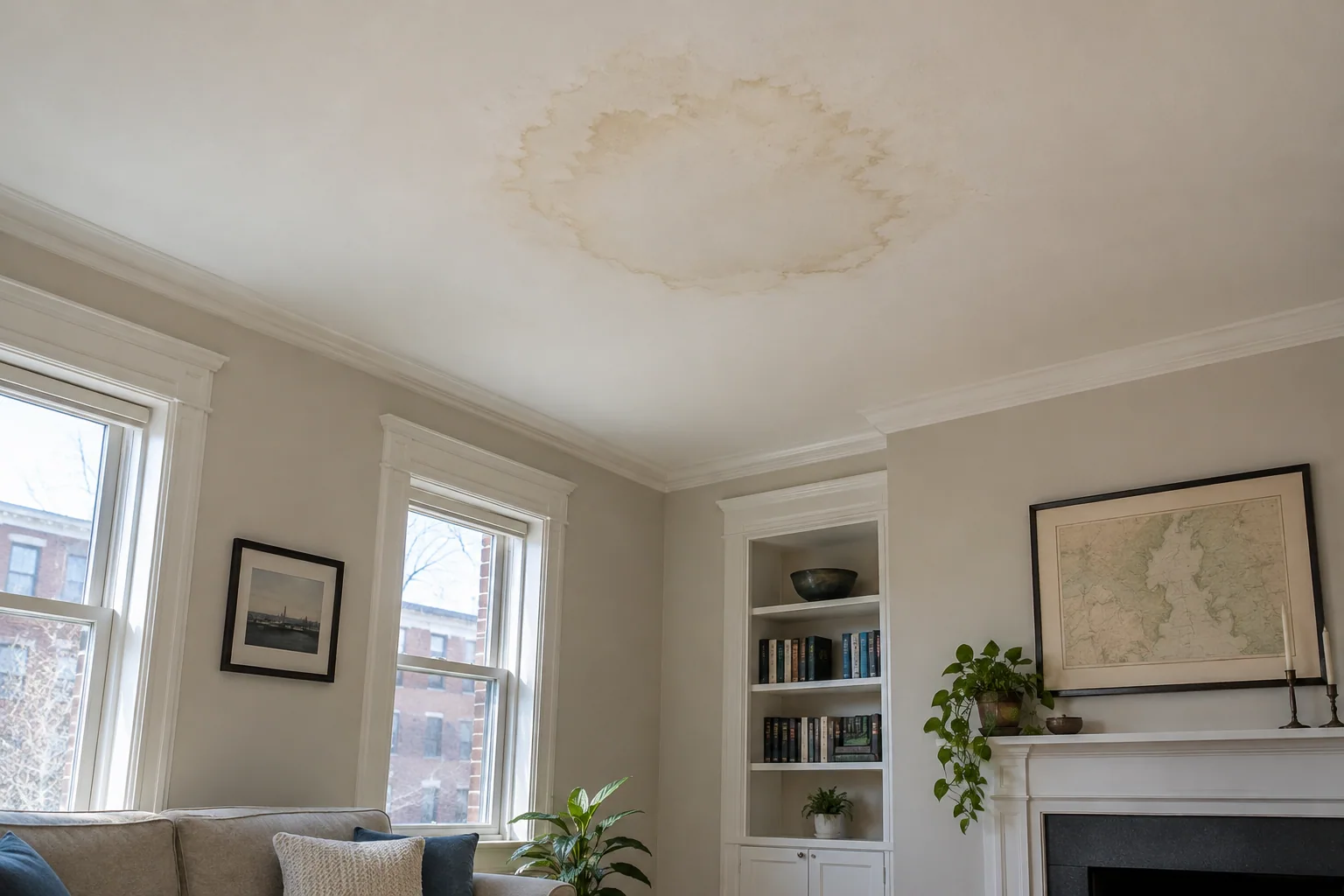
Water at a ceiling fixture or a bulge in the plaster needs immediate attention, whatever the eventual payment arrangement. Keep people away and report the condition to management. Do not puncture the ceiling or remove a light cover. When requesting qualified help, describe whether dripping continues, the ceiling is changing shape or water has reached electrical equipment.
Contact the manager through the building's emergency channel if one exists. Send a short written follow-up stating the unit, room, discovery time and observations. The upstairs owner may be away, or the actual source may serve several apartments. A message that asks for access and source control is more useful at this stage than a conclusion about who caused the damage.
Build a timeline with visible facts
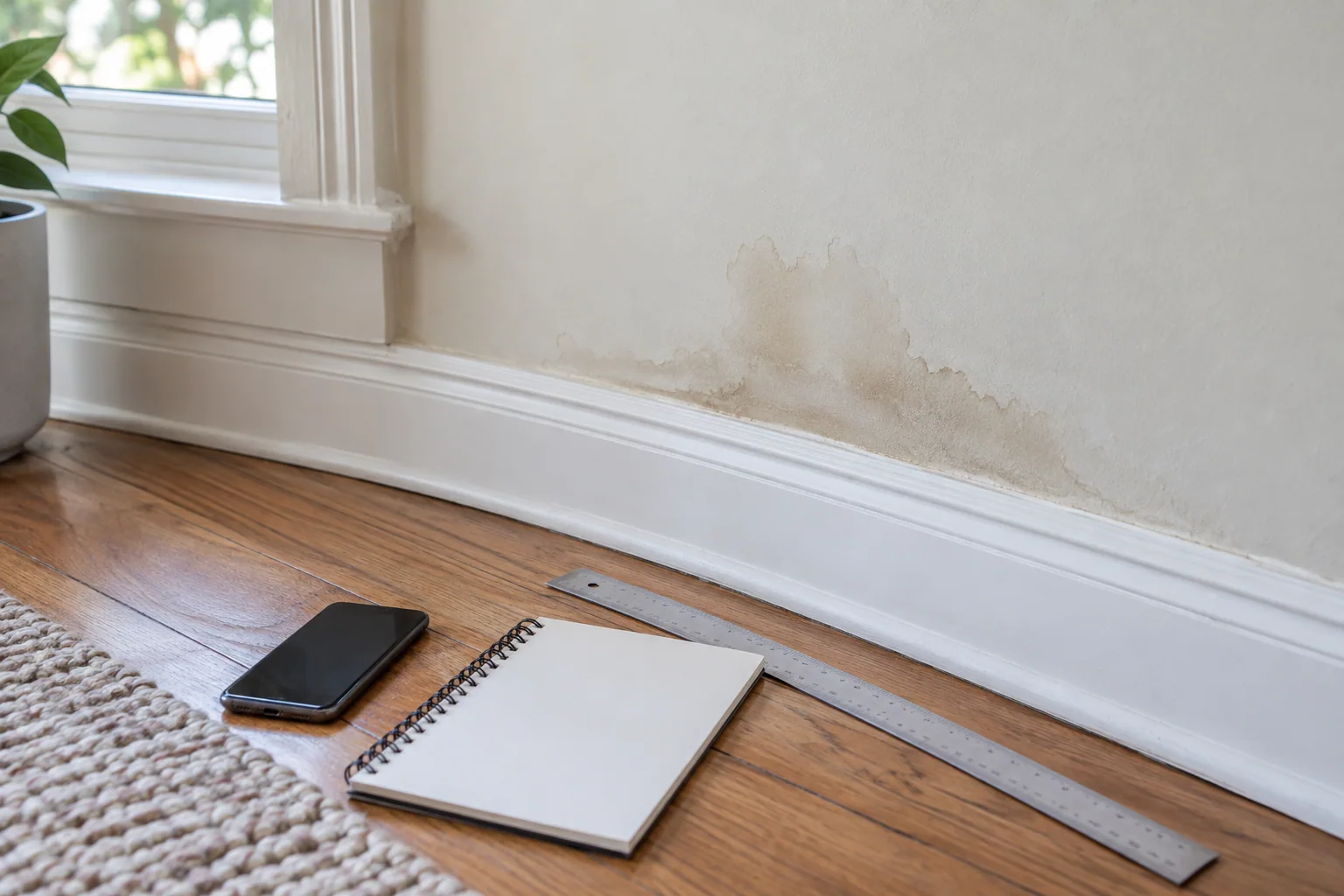
Start the record with what you know: when the ceiling last appeared normal, when you first noticed water and when someone stopped or repaired a suspected source. If a stain expanded overnight, photograph it again from the same position. Record phone calls and access attempts as short dated notes. Save original emails and photographs together so that the sequence remains clear to someone who was not present.
Label secondhand information as secondhand. If the upstairs resident reports a dishwasher problem, record that report without declaring the machine responsible before inspection. Request the plumber's findings and repair invoice. Dripping can stop while the cause remains uncertain; keeping the distinction clear lets the investigation develop without creating conflicting versions of what happened.
Map the building across unit boundaries
A ceiling below a bathroom may contain supply lines, drains and wiring that do not align neatly with the stain. In an older converted house, later renovations can add another layer of uncertainty. Ask the team to identify the affected assembly and the spaces that provide access to it. Your ceiling photograph alone cannot show the upper face of the subfloor or insulation above it.
Coordinate one inspection plan through the manager where possible. It should name the units requiring entry, the person arranging appointments and the method for recording findings. If contractors visit separately, request that they share the same room labels. A report calling a location the rear bedroom and another calling it the second-floor office can otherwise obscure that both describe the same wet floor system.
| Record | What it establishes | What it does not establish alone |
|---|---|---|
| Ceiling photographs | Visible condition and changes | The exact source or legal responsibility |
| Plumber's findings | Observed defect and work performed | Whether concealed materials are dry |
| Moisture inspection | Conditions at tested locations | Insurance coverage for the loss |
| Governing documents and policies | Relevant terms and boundaries | The physical cause of this particular event |
Keep responsibility and coverage as separate tracks
A leak originating above you does not by itself answer who must pay for every damaged finish. Ask the association for the relevant governing documents, the master policy contact and its procedure for handling losses. Notify your own insurer and describe the facts. If coverage or responsibility is disputed, request a written explanation tied to the applicable document rather than relying on hallway advice.
Massachusetts Division of Insurance guidance describes condominium unit-owner coverage alongside association insurance and possible loss assessments. Those are reasons to involve both the manager and your insurer, not a formula for assigning a particular claim. Deductibles, unit boundaries, improvements and the cause of loss can require separate review. A qualified Massachusetts attorney can interpret a disputed obligation when the documents do not resolve it clearly.
Agree on what contractors may open
Before nonemergency demolition begins, ask who is authorizing access to each part of the assembly. A limited ceiling opening may be useful, but it should have a purpose: locating the source, checking a cavity or removing unsalvageable material. The proposal should identify protection for your belongings, dust control, debris handling and the person responsible for restoring the opening after the investigation.
Older painted surfaces and unknown insulation deserve attention before disturbance. Ask the contractor how they will evaluate potential lead or asbestos materials and what qualified trades the work requires. You do not need to choose an opening size or sampling method yourself. You do need a clear explanation of how the inspection will avoid spreading debris into occupied rooms and neighboring units.
Document disruption as well as damaged finishes
Keep a list of affected belongings, rooms you cannot use, equipment placement and access dates. Photograph contents before they leave for cleaning, and request an inventory for any pack-out. Retain invoices for approved emergency work and ask your insurer which additional expenses need advance discussion. Document the expense and its reason; do not assume every inconvenience creates a reimbursable item.
Noise, restricted room access and repeated visits are easier to manage with a named contact and a schedule. Ask when readings will be taken and who will contact you if the plan changes. If you cannot remain in the unit safely, get advice from the responsible officials and insurer about next steps. An equipment pickup date should never stand in for a decision about occupancy.
Close the incident with a shared repair record
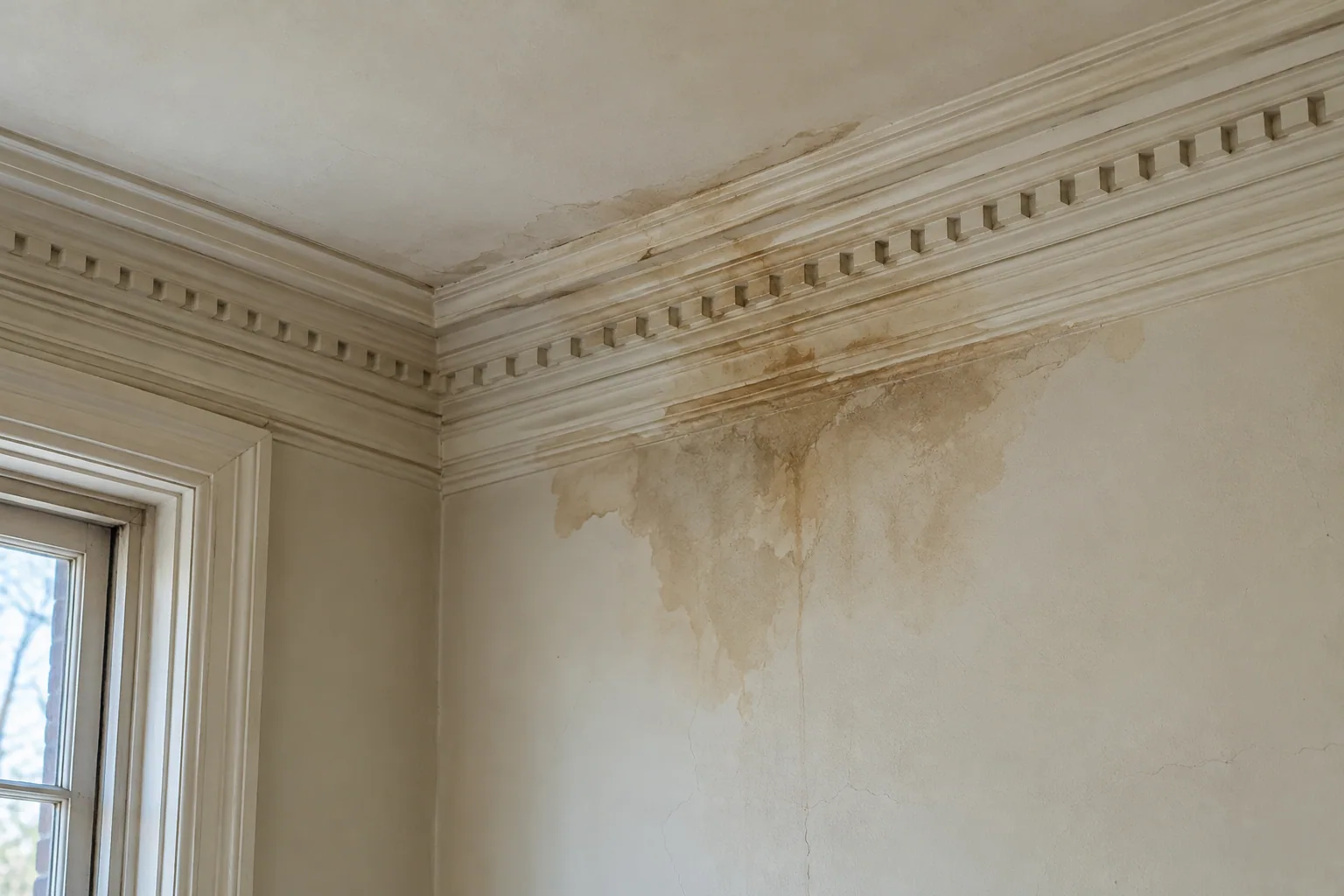
Before the ceiling is patched, request the source-repair record, inspection findings and drying documentation for the affected assembly. Check that the scope includes the full visible finish: a small ceiling patch may also require matching a cornice, repairing trim or repainting a defined area. Agree on the finish boundary before the last contractor arrives rather than after a conspicuous rectangle appears overhead.
Store the final records with the unit's maintenance documents. Note any remaining monitoring, access restriction or unresolved cause. If the stain returns, compare it with the earlier photographs and report the recurrence promptly. A tidy final file serves future maintenance as well as the current claim; the next owner or manager should not have to reconstruct the event from an invoice that says only ceiling repair.
Your field checklist
- Report active water and ceiling hazards through the building's emergency channel.
- Keep discovery times, original photographs and contractor findings together.
- Coordinate inspection access above and below the visible damage.
- Notify your own insurer and ask management about the master policy process.
- Get authorization and repair responsibilities clear before openings are made.
- Save source-repair and drying records before the ceiling is closed.
A few common questions
Should I send the upstairs neighbor an estimate immediately?
Share factual documentation and coordinate source control first. A complete estimate usually needs inspection of concealed conditions. Discuss payment and responsibility through the appropriate owners, manager and insurers rather than treating an early estimate as proof of liability.
Can drying happen entirely from my unit?
Sometimes access from below is sufficient, but the assembly may also require inspection from above. Ask the contractor to explain how the subfloor, cavity and any insulation will be checked. Access should follow the building conditions, not the easiest appointment schedule.
What if the upstairs unit will not provide access?
Record the request and contact the association or manager promptly. Use emergency services for immediate hazards. Questions about compelled access or payment require the governing documents and qualified legal advice; do not enter another unit without authorization.
Sources & further reading
- Understanding Home InsuranceMassachusetts Division of Insurance
- Finding Mold and MoistureU.S. Environmental Protection Agency
- Lead Renovation, Repair and Painting ProgramU.S. Environmental Protection Agency
This guide supports informed conversations about your home. Conditions, materials and local requirements vary; an on-site assessment is necessary for decisions about a particular property.