The useful starting point
A moisture meter can help locate wet areas and track change, but its reading must be interpreted for the material and instrument. Ask what scale is being used, where the comparison readings came from and how hidden layers were evaluated. A low surface reading does not certify an entire assembly or rule out mold.
Begin by asking what the number measures
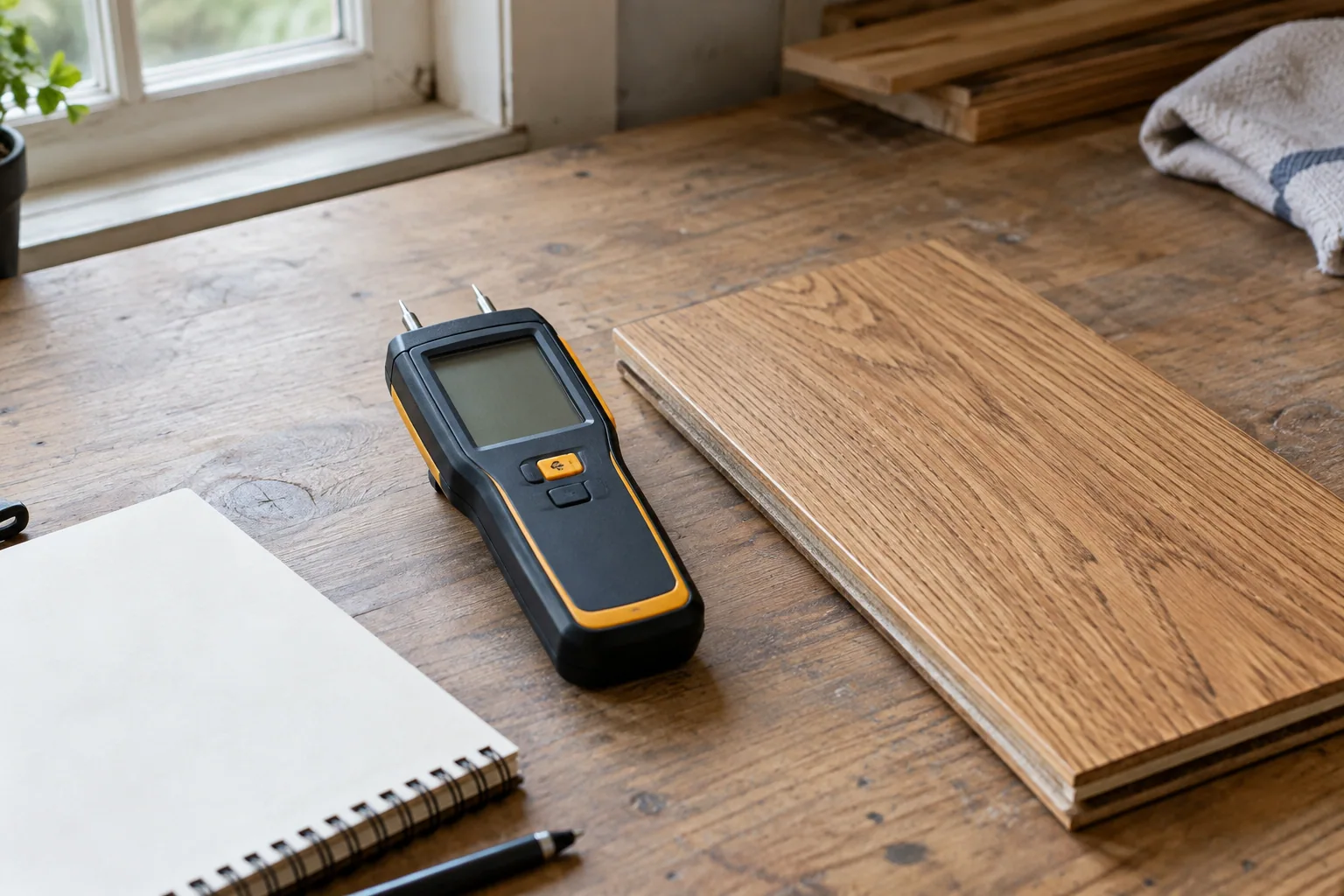
What does the display actually measure? It may show a percentage for a supported material or a relative scale for comparing locations. Ask the inspector to identify the device, mode and material setting before interpreting a high or low number. A reading labeled only moisture is difficult to compare with a later visit or use to decide which material needs repair.
Flir explains that pinless readings often need comparison with similar material of known dryness. A value on that relative scale should not be treated automatically as a percentage of water in the wall. Ask for the interpretation in plain language: what makes this location different, how confident is the inspector in that difference and what additional check would confirm the finding?
Pin and pinless tools answer related questions
Pin meters use probes that contact the material; pinless tools scan through a contact surface without making the same probe holes. Their operating principles and measurement depths differ by model. Ask which method the inspector selected and why it fits the surface. Finished hardwood, plaster over lath and a masonry wall are not interchangeable test materials.
A noninvasive scan can help identify a pattern that deserves closer attention. It does not remove the need for judgment about what lies beneath the surface. Metal and changes in construction can affect readings. Where a result is unexpected, ask the inspector to explain how they checked for interference rather than assuming either that the wall is saturated or that the instrument is useless.
| Tool or reading | Useful role | Limit to keep in mind |
|---|---|---|
| Pin moisture reading | Assess a supported material at the probe location | Settings, contact and tested depth matter |
| Pinless scan | Compare areas and look for patterns | Underlying materials can influence the result |
| Room humidity reading | Describe moisture in the room air | It does not directly measure the subfloor |
| Thermal image | Locate surface temperature patterns | Temperature is not a direct moisture measurement |
A good comparison is part of the measurement
Ask where the inspector obtained a comparison reading and why that spot is appropriate. Comparing a wet-looking plaster wall with an unrelated wood door does not answer the same question as comparing similar plaster construction nearby. Thickness, backing and finish can matter. The report should make the comparison understandable instead of giving two numbers that happen to come from different objects in the room.
A comparison area can also have its own moisture history. If the whole basement has been damp, a nearby wall may not be a sound reference simply because it lacks a stain. Ask how the inspector established the reference condition and whether other observations support it. The purpose is to avoid a false sense of precision, not to demand that every home have an identical numerical target.
Use a map to make repeat readings meaningful
Repeat readings need repeatable locations. A room name, wall orientation, height or board position and a photograph help identify the same spot next time. Keep the date and instrument information beside the result. A later technician should be able to return to that location instead of measuring somewhere nearby and treating the difference as drying progress.
Ask whether the contractor records both affected locations and suitable reference locations during drying. A falling number may indicate progress, but the interpretation should account for the same material and measurement method. If equipment or settings change, that should appear in the record. You should not have to guess whether a sudden improvement reflects a drier wall or a different scale.
Know what a thermal image actually shows
Thermal cameras detect surface temperature patterns; they do not see through an opaque wall. Flir's guidance explains that moisture can influence those patterns, which is why imaging can help guide an investigation. The inspector still needs to interpret the pattern and confirm the relevant condition. A blue or purple shape is not a direct photograph of water inside the wall.
Ask what else could explain the pattern and how the area was checked. Insulation differences, air movement and building details may need consideration. A report should pair an image with location, conditions and supporting findings. An attractive thermal picture without interpretation can be less useful than a simple room sketch showing where the investigator found an active leak and confirmed moisture.
A meter cannot answer every damage question
Moisture readings do not identify mold species, establish health risk or prove the strength of a damaged beam. They also do not establish that a contaminated surface has been cleaned adequately. Those questions need the appropriate inspection or specialist. Ask the contractor to explain which conclusion comes from measurements and which comes from other observations, material condition or professional assessment.
A low reading at a dry face does not necessarily describe the full depth behind it. Ask how an insulated wall, layered floor or closed cabinet was evaluated. If the method cannot reach the area of concern, the limitation should be explicit. Sometimes another test or a carefully planned opening is needed; the reading itself should not be used to pretend that the hidden space was inspected.
Read the report before authorizing closure
A useful report connects readings to the repair decision. It names the tested materials, explains the relevant comparison or target and identifies unresolved areas. Ask the drying contractor how the evidence supports removing equipment or closing a wall. If a new flooring product requires additional substrate testing, the installer should establish those requirements independently rather than treating every moisture report as interchangeable.
Homeowners can keep observational records without making invasive tests. Avoid driving pins into unknown walls where wiring, plumbing or hazardous materials may be present. If you own a meter, follow its instructions and use its readings as information to discuss with a professional. Bring the record, including settings and locations, rather than presenting a single unexplained number as proof of a hidden defect.
Your field checklist
- Identify the meter, mode, scale and material setting.
- Ask how comparison areas were chosen.
- Tie readings to repeatable locations and dates.
- Distinguish room humidity and thermal images from material measurements.
- Record access limits and other possible explanations for unusual readings.
- Connect final findings to the specific repair or installation decision.
A few common questions
Is a reading of 20 always high?
It cannot be interpreted without the instrument, mode and material. A relative-scale value and a wood moisture-content percentage mean different things. Ask for the manufacturer's guidance and the inspector's comparison before drawing a conclusion.
Why do two meters give different readings?
They may use different methods, scales, settings or depths. Ask whether the measurements are comparable and whether each device is being used according to its instructions. A disagreement needs interpretation rather than averaging unlike numbers.
Can a meter tell whether there is mold behind the wall?
It can help find moisture conditions that deserve investigation, but it does not directly identify mold. Ask an experienced professional to evaluate the history, visible condition, odors and any justified concealed-space inspection.
Sources & further reading
- Wet and Dry Moisture Meter ValuesFlir
- What Is the Right Moisture Meter for Me?Teledyne Flir
- How to Detect a Water Leak with Thermal ImagingFlir
- Finding Mold and MoistureU.S. Environmental Protection Agency
This guide supports informed conversations about your home. Conditions, materials and local requirements vary; an on-site assessment is necessary for decisions about a particular property.